
Creativity's payback time: why forcing distance was never free of charge.
Here is the exact price of real creativity.

In 1962, a psychologist wrote down what creativity actually is: pulling together ideas that sit far apart, and the further apart, the more creative the result.
Sixty-four years later, most writers with a chat window are doing the opposite, reaching for the nearest idea the model offers.
The whole game is distance.
The two-move method is how you force it, then pay to keep it usable.
But before the method, look at what most people believe about creativity techniques.
Everyone knows the pitch by now.
Find the right technique, the right prompt, the right exercise, and your output gets better across the board: more original, more on-brief, more everything, all at once.
A good technique, the thinking goes, only adds.
It is a “free lunch” you have not ordered yet. Pick it up and the work improves with no cost attached.
That belief feels obvious, and it is wrong in a way that costs you ground.
The truth runs the other direction.
The ad studios that formalized these operators in the 2000s knew it first, and they priced it in.
Why associative distance is the whole game
Start with the definition itself.
In 1962, Sarnoff Mednick published “The associative basis of the creative process“ in Psychological Review, and the sentence at its center has held for over sixty years.
Mednick defined creativity as the combining of remote associations into something useful, and the more remote the elements, the more creative the result.
This means creativity is not a substance you have more or less of, but the distance you cover between things that do not usually sit together.
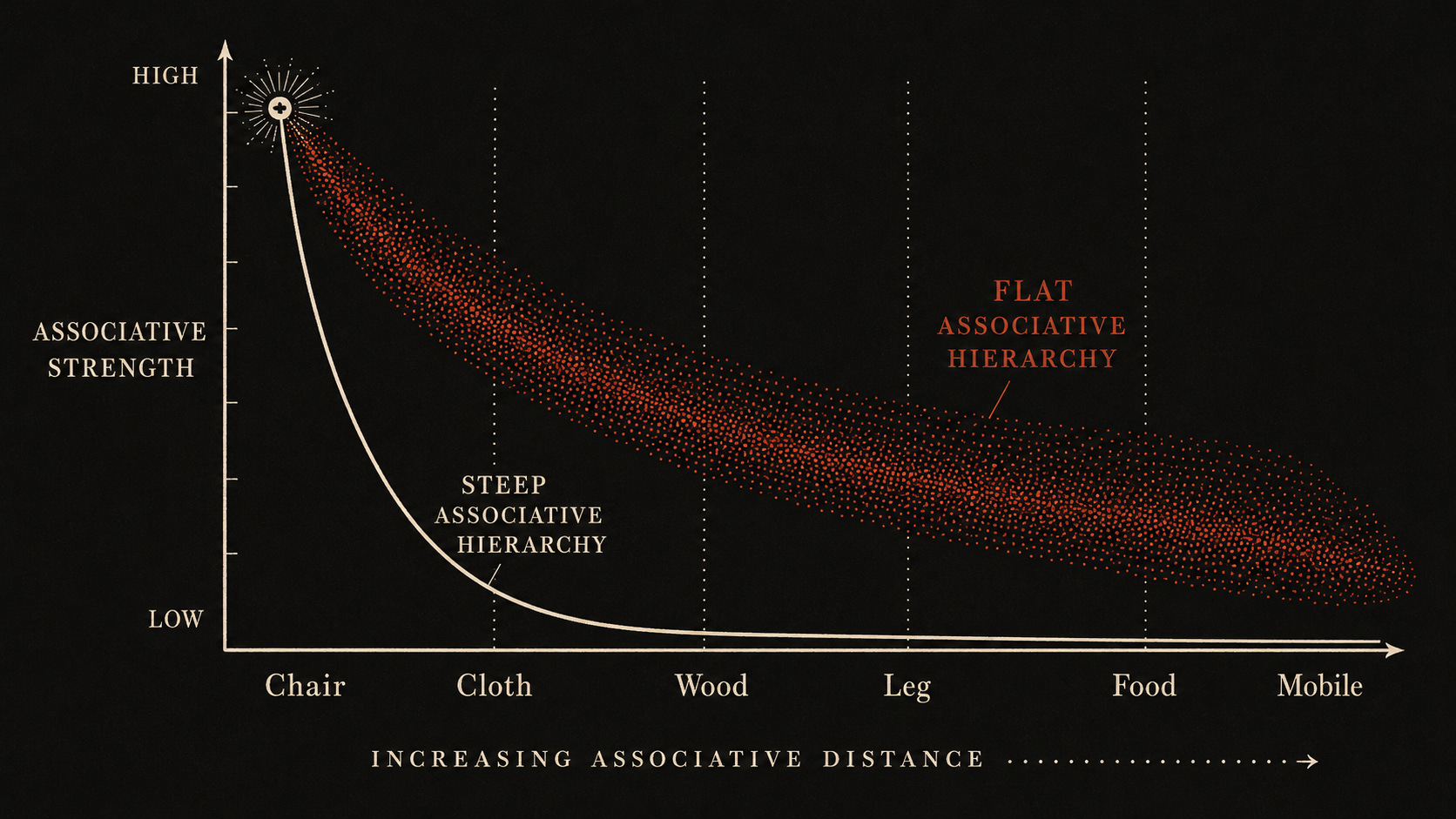
Mednick’s mechanism for that distance was the ASSOCIATIVE HIERARCHY: the ranked set of responses a mind produces when prompted with a cue.
Give someone the word table, and one response dominates, chair, with everything else falling off fast behind it.
That is a steep hierarchy: The first answer swallows nearly all the available probability, and the remote answers sit so deep they rarely surface.
A flat hierarchy behaves differently: The first response is less dominant, the curve descends slowly, and more associations stay live and reachable further out.
Mednick’s testable prediction followed directly.
Creative people have flatter hierarchies.
Slower at the Start, deeper at the edge
So creative minds start slower, because no single obvious answer is pulling all the weight, but they reach distant associations that the linear mind never gets to.
He named three routes to that remote combination:
Serendipity, where chance throws two far elements together;
Similarity, where a perceived likeness bridges two domains;
And mediation, where an intermediate element links the two.
From this he built the Remote associates test, the instrument that measures whether a person can find the single word connecting three unrelated stimuli.
But the model did not survive untouched. Revisiting the model five decades later, Benedek and Neubauer found that associative hierarchies did not clearly differ between low- and high-creative groups.
The stronger differences appeared in associative fluency and uncommon responses, not in the hierarchy shape alone. Mednick had the result roughly right and the exact mechanism slightly wrong, which is the normal fate of a foundational idea.
The core has held: remoteness is the raw material of original combination, and reaching it is the work.
When I first read that paper, I recognized the move I watch a model make every day: grab the nearest answer and call it finished.
This matters because it tells you what a creativity technique is actually for.
Talent matters less here than the operating conditions you create.
The technique flattens the hierarchy on demand, keeping the distant associations reachable when your default mind, or your default model, would collapse onto the nearest one.
That is the function and everything that follows is about the cost of doing it.
What the studios knew, and your prompt forgot
You can watch this happen outside any computer.
In the advertising studios of the 2000s, Jacob Goldenberg and his colleagues formalized a set of creativity templates, named operators like subtraction, unification, and extreme consequence, that constrained how a team attacked a brief.
The point was not inspiration.
It was structure: force the idea through a narrow operator, remove a component, fuse two functions, push a consequence to its limit, and the output drifts off the obvious.
A later study in the Journal of the Academy of Marketing Science tested ideation templates in professional advertising development and linked them to creative performance.
Then the bill arrives…
On a model, it arrives in a currency the studios never paid: compute.
The model defaults to the convergent answer, the dead center of the distribution, because that is the response it was trained to reward.
Handing you the center is cheap.
Pushing it off the center is where the cost shows up, and in production I watch it run line by line: every step toward a genuinely distant association burns tokens, and the price climbs the further out you push (the divergent draft is the one that empties the budget).
I burned through more compute than I want to admit before I started planning for that line. The far answer is the expensive one to produce, and that bill is what nobody budgets for.
That is what the prompt crowd inherited without the receipt.
The template operators circulate today as prompt instructions, force a metaphor, subtract a feature, push the consequence, but they travel as upgrades, stripped of the one thing the studios always knew: the distance you force is borrowed, and the brief has to be bought back.
Where the bill lands in your workflow
So what changes for how you work?
Mostly this: you stop treating distance as something you either have or lack, and start treating it as something you spend and recover on purpose.
You keep generating angle after angle, and they all come back wearing the same face, the one your three competitors are also shipping this week. Underneath that sameness, the cause is structural, not a failure of talent: a hierarchy collapsed onto its nearest response, yours and the model’s both.
Reach for a better prompt in the same one-pass workflow, and the output often lands where everyone else’s does.
The two-move method moves you: force the angle off-center first, then pull it back to the brief on purpose, and the sameness stops being your ceiling.
The production protocol lives elsewhere, but this stripped-down version is enough to test the trade today: force distance in one pass, recover readability in the next.
Skip the recovery pass and you ship maximum distance that lands on nothing, the lyrical draft that converts no one.
Budget for it and the trade works in your favor.
Run it in two moves
Treat a divergence technique as a trade, not an upgrade. Before you reach for it, name the two moves out loud.
Here are both prompts in demo form, deliberately stripped down (no emotional entries, no compliance checks). Remember, this is a tasting, not the production protocol.
First, force the angle off-center and accept that the draft drifts off-brief; that is the technique working, not failing.
Here's my raw material: [paste specs / facts / context]
Recipient: [who reads this]

1. The Core Fact (The Brief): Extract the naked truth from the raw material.
   In one single sentence, state exactly what the product does or what the
   recipient concretely gets. Zero adjectives, zero marketing words.
   Strictly factual. This is what must survive everything below — keep it.

2. Now give me your reflex formulation — the first angle that comes to you.
   That's the anchor. We're going to move away from it, not keep it.

3. WITHOUT changing the subject, produce 6 angles that move away from that anchor, two per route to remote association:

   SERENDIPITY (chance collision of two far elements)
   - pick a concrete object or scene from everyday life BEFORE you know how it connects, then force the Core Fact through it — keep the collision, even if it's awkward
   - take two details already in the raw material that have no reason to sit together, and write the angle that only appears once you force them into the same frame

   SIMILARITY (a likeness bridges two domains)
   - one cross-domain analogy: map the Core Fact onto a domain FAR from the material (not tech, not marketing) — the mapping must carry a specific mechanism, not a vibe
   - find a tension, cause or dynamic INSIDE the material and mirror that same structure onto what the recipient actually experiences

   MEDIATION (an intermediate element links the two)
   - surface the hidden middle term: the unstated step B that sits between the Core Fact and why the recipient should care — write the angle on B, the thing no one names
   - follow the chain outward (the fact enables X, which enables Y) and write the angle on the far end, not on the fact itself

For each angle: first say in one line WHERE you're going, then write the angle.
Stay on the surface: what the recipient gets, does, or concretely avoids — never what they feel or become.
End each with: already seen? Yes / Maybe / No — and where.
Then run a separate, deliberate pass to pull it back to the strategy.
Open a fresh window with the first prompt closed, or the model drifts straight back to its reflex. (Stating the obvious, but just in case: don’t forget to re-inject the raw material.)
Distant angle I'm keeping: [paste the angle you chose above]

The Core Fact to make readable (paste it verbatim from step 1):
[the one-sentence factual truth]

Rewrite this angle so that the Core Fact becomes READABLE in a single pass —
but keep the distance: the structure, the inversion, or the dimension that
made it different has to survive.

Then check, in this order:
- Does a rushed reader get the Core Fact on the first read? If not → rewrite.
- Has the angle collapsed back into the obvious formulation anyone would have
  written? If yes → you've over-bought. Back off, recover the distance.
Compare this two-move protocol to your usual one-shot prompt, and the results will speak for themselves.
Thibaut Buewaert
Editor of Machine Writing.
P.S. Starting next week, we’re opening a new thread: writing voice profiles. How to build yours, and above all how to get the model to adhere to it. More to come.
P.P.S Here is the exact output of this double-pass protocol run on this very article:
[Pass 1: The Divergent Angle]
SIMILARITY → Where I’m going: deep-sea diving, far from tech, mechanism first.
A diver reaches the wreck in one drop. Coming back up is the part that kills you if you rush it: you ascend in fixed stages or the dissolved gas turns on you. Distance is the descent; the recovery pass is the decompression stop. Skip the stop and you surface with something no one can read.
Already seen? No. (Mechanism that carries: staged ascent = a separate, deliberate second pass — not a vibe.)
[Pass 2: The Recovery Rewrite] Here’s the recovery-pass rewrite — the diving frame intact, the Core Fact surfaced:
Diving is two moves, and so is the creativity. The first prompt is the descent: one drop straight past the model’s default answer, down to the wreck — the farthest association you can reach. The second is the ascent, and you run it separately, in fixed stages, because that’s the part that kills you if you rush it. On the way up you rewrite the draft to restate your one factual sentence, but you hold the depth you bought — rising slow enough that the pressure never turns the dissolved gas against you. Two prompts, opposite directions: down to where it’s strange, back up to where it can be read. Skip the ascent and you surface with something no one can read.
[The Compliance Checks] Running the two checks:
Does a rushed reader get the Core Fact on first read? Yes. All three load-bearing pieces are now on the surface, not buried in the metaphor: two separate prompts (”two moves… you run it separately”), the first moves off the default (”straight past the model’s default answer… the farthest association”), the second restates the one factual sentence while holding distance (”rewrite the draft to restate your one factual sentence, but you hold the depth you bought”). The line “down to where it’s strange, back up to where it can be read” is the catch-net for anyone skimming.
Has it collapsed into the obvious formulation? No. The thing that made the angle distinct — the inversion that the return is the dangerous part, not the plunge — is still doing the work (”that’s the part that kills you if you rush it”). The depth/pressure dimension and the staged-ascent-as-decompression structure both survive. It hasn’t flattened into “do two prompts, one for distance and one for clarity,” which is what anyone would have written.
[1]. Mednick SA. The associative basis of the creative process. Psychological Review. 1962;69(3):220-232.
[2]. Benedek M, Neubauer AC. Revisiting Mednick’s model on creativity-related differences in associative hierarchies: Evidence for a common path to uncommon thought. The Journal of Creative Behavior. 2013;47(4):273-289.
[3]. Goldenberg J, Levav A, Mazursky D, Solomon S. Cracking the Ad Code. Cambridge University Press; 2009.
[4]. Tevi A, Parker J, Koslow S, Ang L. Creative performance in professional advertising development: The role of ideation templates, consumer insight, and intrinsic motivation. Journal of the Academy of Marketing Science. Published October 31, 2024. 2025;53:854-875.