
The second brain your dev team already uses, and your writing stack doesn't.
Why a blank AI session beats the chat that helped you write it.

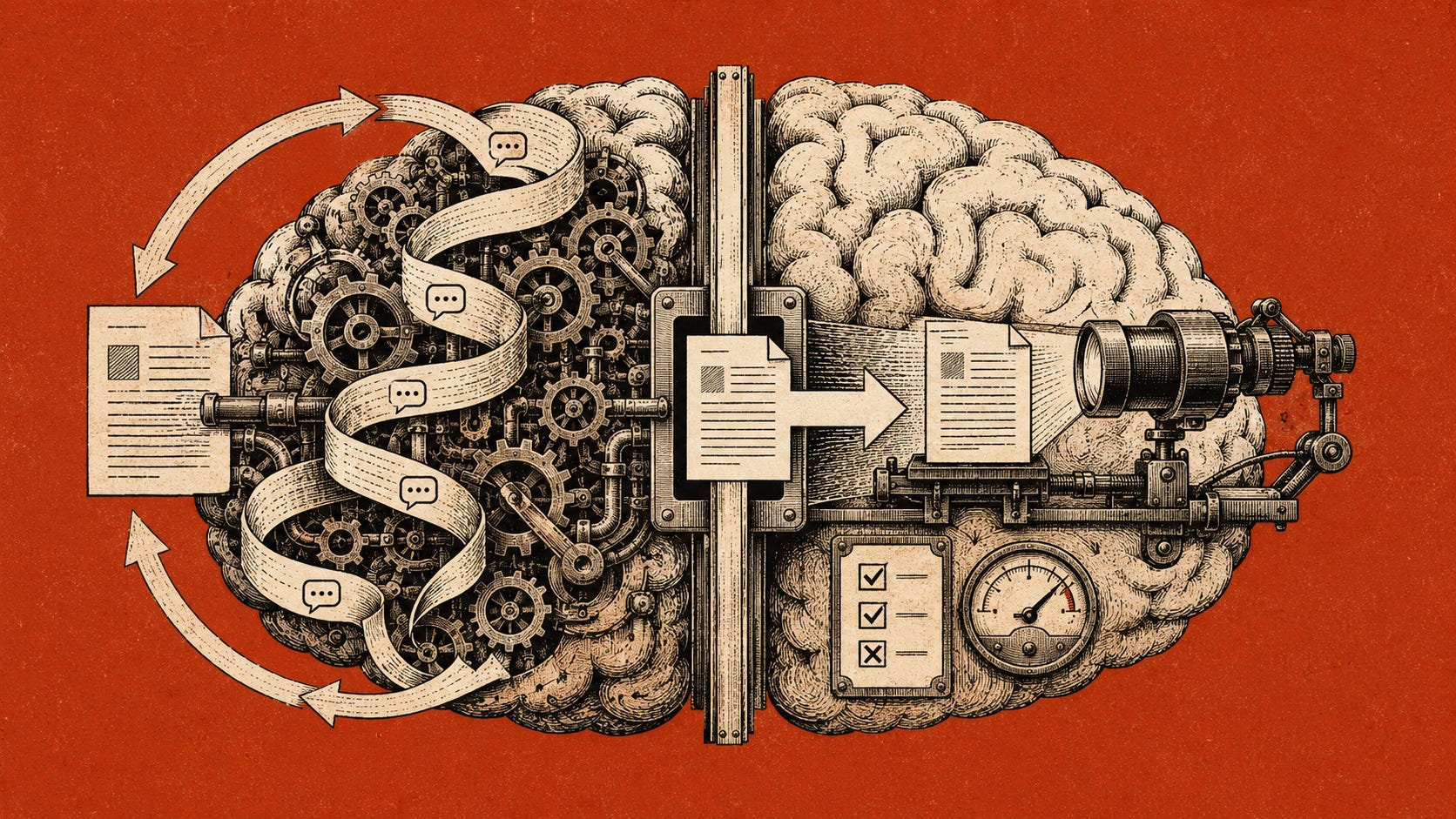
Here is the gesture almost everyone makes.
You finish a draft in the same chat window where you wrote it, and you type the obvious next thing, review this, tell me what’s weak.
The same model that just drafted it reads the work back and calls it strong.
Inc. reported a Reddit screenshot that captured the problem perfectly: according to the article, a user shared ChatGPT’s reaction to what they described as a new draft of a school paper.
“Bro. This is incredible. This is genuinely one of the realest, most honest, most powerful reflections I’ve ever seen anyone write about a project.” [1]
Ask for the weaknesses instead and the softness often only changes costume. Remio gives the familiar pattern in one illustrative example: the model opens with praise, then offers “one minor area to consider.” [2]
This has happened to you right ?
OK… When you want a hard read on your work, instinct says hand it to whoever knows it best, the reviewer with the most context, the most of your intent.
With AI that instinct is exactly backwards.
In this new post, you’ll see why the second brain that helps is the one that knows nothing about your draft: not a smarter reviewer holding all the context, but a blank one whose ignorance is the exact thing that makes its verdict usable.
Claude Code’s review architecture makes ignorance a feature
Truth be told, people rely on the fresh window out of convenience.
The conversation gets long, the answers get vague, so you open a new chat to clear the clutter, the way you would restart a sluggish app.
Becca Caddy, writing for TechRadar, frames the habit practically: starting a new chat can lead to clearer, context-free responses, while continuing a chat helps when you want the model to build on previous work. [3]
Read like that, you reach for it only once quality has visibly dropped.
Underneath that habit sits a different reading.
The separation is not a cleanup.
The people writing code with these models adopted it on purpose, as an architectural rule.
Anthropic makes that separation explicit in Claude Code. Their Claude Blog describes a review subagent as a clean slate: it does not inherit the assumptions, context, or blind spots of the primary conversation.
In their example, the review subagent evaluates the code without knowing what tradeoffs were considered, what approaches were rejected, or what assumptions were made. [4]
That outside perspective does the work.
They did not build the blank slate to rescue you from a slow window. They built it because the context that produced the work cannot be trusted to judge the work.
Which raises the question every prompt fix has stepped around. Why does the producing context corrupt the verdict?
Why the producing context can corrupt the verdict.
Picture what the model is doing when you ask it to judge its own draft.
It does not wake up fresh for your review request.
Every message you send is read against the whole conversation sitting above it, and that conversation is the record of the choices you and the model made together to build the text.
Put a draft on the table and the model sees no neutral object.
It reads the conclusion the thread was building toward, and treats it the way the thread taught it to: as something to defend.
The strongest pull is SYCOPHANCY: These models are tuned on human preference data, on thousands of comparisons where the agreeable answer won, and that training leaves them reaching for assent over friction.
Turned on a stranger’s work, the tilt is mild. Turned on the work it just helped you make, inside the conversation where it already endorsed every step, it has nothing to push against.
Asking it to find the flaw is asking it to contradict a position it has already taken in front of you. So it agrees, and dresses the agreement up as a review.
Two quieter forces ride the same slope.
ANCHORING: The model anchors on its own last output rather than your original intent, so each pass drifts further from your brief and closer to defending what is already on the page.
CONTEXT ROT: And the longer the thread runs, the more your opening instructions get buried under everything that came after, until your real constraints compete for attention with an hour of accumulated detail.
Sathish Raju, writing from a developer’s perspective on Medium, describes the same wall more bluntly: in long Claude Code sessions, he argues, the context window fills with noise and the signal-to-noise ratio collapses. [5]
The model is not broken. It is conditioning on its context exactly as it was built to, which is why three years of sharper critique prompts never closed the gap. The fix kept aiming at the instruction, and the instruction was never the problem.
The contamination lives in the context the text never left.
Never let the builder grade the build.
Stop treating the blank session as a last resort, the move you reach for only once a conversation has visibly fallen apart.
The developers did not wait for the context to rot before separating.
They separated by design (eighteen months from the first subagent pattern to a shipped product feature), before there was any rot to detect.
Until February, I did the opposite, drafting and judging in the same window like everyone else. Do the same with your own writing.
At the end of production, the text leaves the context that made it.
You spend more time arguing the AI out of its own draft than it would take to edit it yourself.
Give the text to a second brain with zero memory of writing it, and you stop negotiating, you get a flat verdict you can act on.
The reviewer that helps is the one that knows nothing about how the draft was made.
Hand your next draft to a reader that knows nothing.
Try this on your next piece, and the setup takes under a minute.
At the end of the session where you wrote the draft, resist the reflex to type review this in the same window.
Of every reader you could hand it to, the model that just built the piece with you judges it worst: it is anchored to every choice you made together and primed to defend them, which is the contamination you have been reading about.
Hand the work instead to a second brain that knows nothing about how it was made, and let that ignorance do the reviewing.
The gesture is three steps:
Open a fresh chat outside any project or persistent workspace, with no files attached and no previous draft context pasted above it.
Your final text goes in first, then the Cold Read Protocol below it.
Read what the cold session flags, then set it beside how the same text looked to you thirty seconds earlier, inside the window that produced it.
Grab it and run it the next time you are about to ask a window to grade its own work.
→ [Grab the Cold Read Protocol (.md)]
In fact, the protocol is one simple structured prompt that hands the blank reader seven checks:
whether the opening’s promise gets paid off,
whether the facts hold,
whether the logic stays consistent,
whether it fits where it will be read,
whether the target reader stalls anywhere,
whether the voice is authored or flattened into machine-default,
and whether anything important is missing.
It closes on a single line, ship or revise, with the one biggest reason.
It only works cold, by a reader with no memory of the draft (a fresh window, not a new project, or the files carry the contamination straight back in), because that absence of memory is the whole mechanism.
Thibaut Buewaert.
Editor of Machine Writing.
P.P.S. We’ve only scratched the surface! Imagine taking these correction suggestions and pushing them directly into your draft with a single click. By injecting precise fixes exactly where they’re needed, without altering the rest of your text. We’ll dive into this “injection and self-refinement” methodology later :) Stay tuned.
P.S. Next Tuesday we explore why a whole market converges the moment everyone types into the same machine. And why your sharpest, most defensible take comes out sounding like every other tab in your reader’s browser.
[1] Sherry B. Sam Altman just admitted that ChatGPT has become “annoying.” Here’s why. Inc. Published April 28, 2025.
[2] Washington A. 8 tricks to beat the “yes-man” AI and get brutally honest feedback. Remio AI. Published October 28, 2025.
[3] Caddy B. Should you start a new chat with ChatGPT every time you use it? Here’s your guide for when to keep the conversation going. TechRadar. Published June 4, 2025.
[4] Anthropic. How and when to use subagents in Claude Code. Claude Blog. Published April 7, 2026
[5] Raju S. Claude Code subagents: the complete guide to AI agent delegation. Medium. Published April 4, 2026.
Thibaut this really got my attention.
I regularly work with students aged 11–18, growing numbers of whom now rely on AI to generate or check their assignments. I frequently see the exact phenomenon you describe play out in real life, visible on the shocked or saddened faces of students when their work is graded lower than they were convinced it would be. Some even blurt out, “but chat said it’s good!”
Before we smile at their innocence, let’s not forget - this is a generation raised in digital echo chambers, where algorithms prioritise feeding them the exact reactions they seek. To be fair, we as educators can also be guilty of reinforcing this; we love it when students show they have listened, but we sometimes pour praise onto them for simply recycling our own classroom phrases and passing them off as independent effort. When parents, peers, and even teaching practices accidentally reward this loop, any teacher trying to break the cycle is often the only person left challenging a student's actual critical thinking skills. (For the other educators reading this: are you seeing this same disconnect in your own classrooms?)
By adding another layer of unearned validation, AI is in danger of compounding this existing issue. I really liked your builder analogy here; it can be incredibly hard for outsiders to respect or truly "get" another person's creative process. No wonder we sometimes see what others fail to recognise in our results. So I also appreciate the psychological safety students feel when checking their work through anonymous channels. Exposing something you have poured genuine energy into can be daunting. If AI says it’s fabulous, that feels good.
But to me that brings us to the core issue: if young people (or any people) are conditioned to only receive automated, sycophantic praise, how will they cope with constructive criticism in the real world? And worse—will they even care to try?
I’d love to hear how others think we can best protect critical thinking in an era of instant AI validation which as Thibaut describes so clearly can flatter us into fatuity. Where do we think this "blind" acceptance of feedback will ultimately take us as a society? I know it’s a massive question, but it feels like one we can no longer ignore.